
The 4th Industrial Revolution: A Strategic Imperative for Ibero-America’s Future
Technology does not transform societies by itself. Institutions do — when they can govern innovation, scale its benefits, and turn disruption into sustainable development.
We are living through the 4th Industrial Revolution — a transformation reshaping production, education, work, politics, and the relationship between States, organizations, and citizens.
Klaus Schwab, founder of the World Economic Forum, identifies what makes this revolution different: it moves faster, reaches further, and transforms deeper than anything before it.
The convergence of Artificial Intelligence (AI), Big Data, Cloud Computing, Cybersecurity, the Internet of Things (IoT), Blockchain, Robotics, and other emerging technologies is not merely a technical evolution; it is a profound paradigm shift that is reshaping how societies produce, decide, lead, and redefine the role of the State.
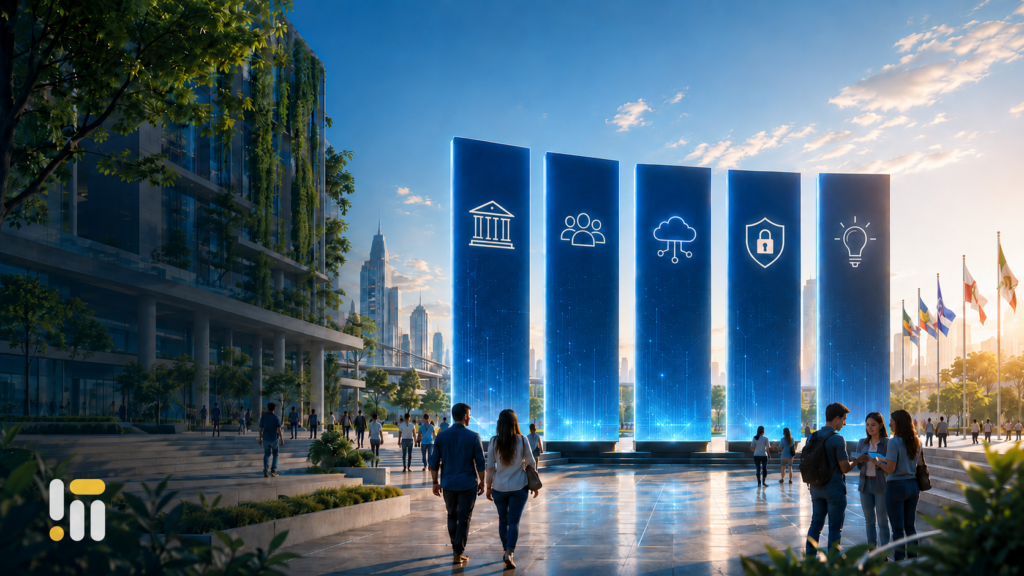
The Techno State — or Tech State — is not a concept for the future; it is the operating model of the century ahead. The next frontier of public leadership will not be defined by digitized procedures, platforms, or automation, but by States capable of governing technology as a source of power, sovereignty, and development. A true Tech State transforms technology into institutional strength: sharper decisions, smarter services, greater trust, and the capacity to turn innovation into lasting prosperity.
This transformation forces a new understanding of sovereignty. In the 20th century, State power was measured by natural resources, industrial capacity, and economic weight.
In the 21st century, sovereignty will belong to nations that can generate knowledge, protect data, build digital infrastructure, fuel innovation, and govern critical technologies. Technological independence is no longer optional — it is the foundation of strategic autonomy and long-term development.
Yet Ibero-America faces a challenge greater than the global debate on artificial intelligence: the risk of being left behind in the race for technological capabilities. The old idea of a digital divide is no longer enough. The real gap is deeper: infrastructure, education, digital literacy, scientific research, innovation investment, technological development, and specialized talent. It is not simply a connectivity gap; it is a capabilities gap.
The stakes are decisive. Countries that build talent, strengthen innovation ecosystems, and develop their own technological capabilities will shape the future: competing globally, attracting investment, creating value, and driving sustainable growth.
Those that do not will deepen their dependence and fall further behind in a world where knowledge, data, and innovation are the new strategic assets.
Yuval Noah Harari’s reflections sharpen the urgency of this challenge. He warns that the 21st century could produce a new and deeper form of inequality — one defined by the ability of individuals, organizations, and States to understand, develop, and command emerging technologies. The greatest risk is no longer only that machines replace certain tasks, but that entire societies are pushed to the margins of the knowledge economy because they failed to build the capabilities required to shape it.
The technological gap is no longer just a digital divide. It is a development gap. The real challenge is not only to connect with more people or adopt more tools, but to build the foundations that determine who lead stronger education, applied research, innovation, talent, and institutions capable of governing technological change.
In this defining moment, institutions like the Ibero-American Institute of Technology (ITECH) have a mission that goes far beyond analysis. ITECH is called to shape the technological agenda for Ibero-America: generating knowledge, connecting disciplines, and transforming innovation into a force for sovereignty, development, and shared prosperity.
The 4th Industrial Revolution is no longer approaching — it is the arena in which nations will define their future. Leadership will not belong to those that simply acquire more technology, but to those that build talent, knowledge, innovation capacity, and institutions needed to command change with strategic vision.
Technological development must not be judged by how many devices are connected, procedures are digitized, or solutions are implemented. Its real measure is whether it expands human potential, strengthens democratic institutions, raises competitiveness, and reduces inequality.
The 4th Industrial Revolution is already rewriting the rules of power, wealth, and development. Its impact reaches far beyond technology: it is reshaping the foundations of sovereignty, competitiveness, and social progress.
For Ibero-America, the challenge is no longer to follow the technological transformation from behind. It is to lead with purpose: building the institutions, talent, and strategic vision required to govern technology and turn knowledge into sustainable development, innovation, and wellbeing for its societies.
Technology does not change the world on its own; institutions capable of governing it do.
Key Insights for Understanding the Techno-State and the Fourth Industrial Revolution
What is the Techno State and why is it relevant to Ibero-America?
The Techno-State —or Tech State— is a model of public governance that goes beyond digitizing procedures or automating processes. It is defined by a State’s ability to understand, govern, and strategically use technology as a tool for development. In the Ibero-American context, where the gap in technological capabilities remains significant, building effective Tech States is a necessary condition for competing in the global economy of the 21st century.
What distinguishes the Fourth Industrial Revolution from previous ones?
According to Klaus Schwab, founder of the World Economic Forum, the Fourth Industrial Revolution is distinguished by three characteristics: the unprecedented speed at which technologies are evolving, the global scale of their impact, and the depth of the transformations they generate across the economy, institutions, and society. Unlike previous revolutions, it does not unfold sequentially but simultaneously across multiple sectors, requiring equally agile and coordinated institutional responses.
Why is the digital divide no longer sufficient to describe the region’s technological challenge?
Because the problem is no longer just about connectivity. The real technological divide encompasses access to digital infrastructure, quality education, digital literacy, scientific research, investment in innovation, and the development of specialized talent. In essence, it is a gap in capabilities and development. Countries that fail to invest in these areas risk being excluded from the knowledge economy, deepening their technological dependence on the powers that lead innovation.
What is ITECH's role in this landscape?
The Ibero-American Institute of Technology (ITECH) operates as a regional think tank with a purpose that goes beyond analyzing trends. Its mission is to generate knowledge, promote interdisciplinary dialogue among academia, business, government, and civil society, and contribute to the development of concrete proposals that can transform technology into a genuine instrument for economic, institutional, and social development across Ibero-America.
How is the true impact of technological development on a society measured?
Not by the number of connected devices or digitized procedures, but by its ability to improve people’s quality of life, strengthen democratic institutions, increase the competitiveness of economies, and reduce inequalities. Technology does not change the world on its own; institutions capable of governing it with strategic vision and a commitment to the common good do.